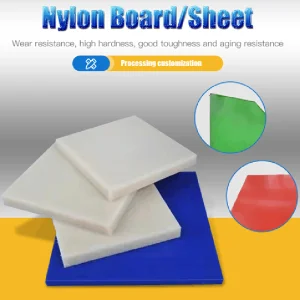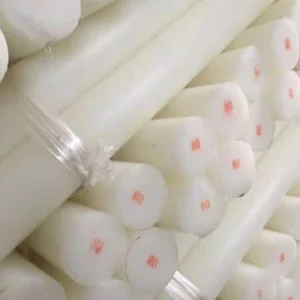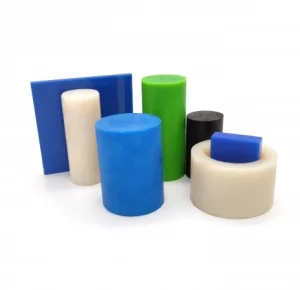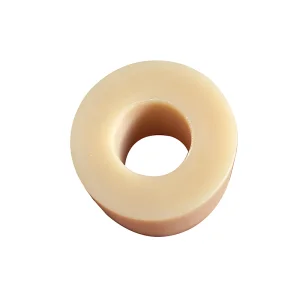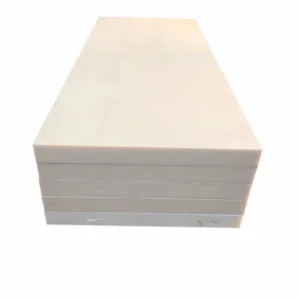
Factory Stock Available
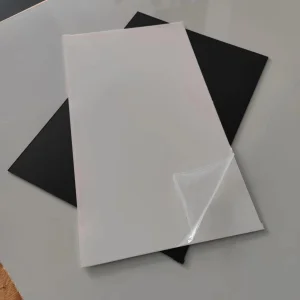
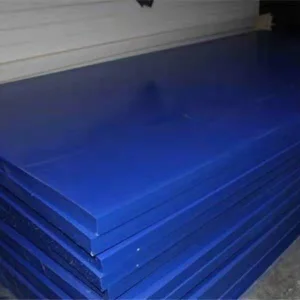
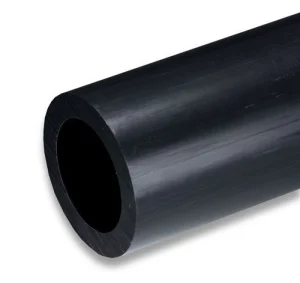
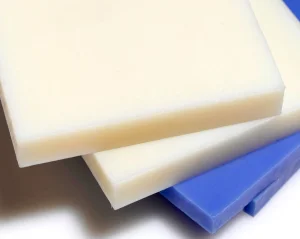
Direct Precision Plastic Blocks & Stock Profiles
Verified semi-finished stock, precision cast plates, and profile extrusions ready for worldwide immediate dispatch from our centralized manufacturing facility.
Material Science & Thermodynamics
Engineering PA6 Blocks: Controlling Crystallinity & Minimizing Internal Stress
Why raw PA6 extruded blocks and anionic polymerization cast nylon (MC Nylon) yield distinctly different structural behaviors during 5-axis subtractive milling.
Atmospheric Monomer Casting
Unlike injection-molded granules that introduce anisotropic shear patterns, our Cast PA6 (Monomer Cast) utilizes activated caprolactam monomer directly polymerized inside pre-heated dies under ambient pressure.
- Crystallinity exceeding 52% (vs 35-40% extruded)
- Molecular weight: 300,000–500,000 g/mol
- Zero centerline shrinkage cavity defects
Thermal Annealing Protocol
Machining warpage is prevented at the molecular stage. All thick-section PA6 blocks undergo liquid-bath or inert-air hyperbaric thermal conditioning over 48 to 120-hour cyclic ramps.
- Eliminates latent casting core tension
- Allows micron-level dimensional tolerances
- Preserves flatness during deep pocket milling
Modified Additive Blends
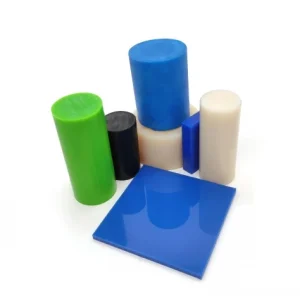
We synthesize custom formulations tailored for tribological extremes, ranging from MoS2 dry-lubricated blue grades to oil-filled nylon for continuous heavy conveyor wear plates.
- PA6 + Oil: Dynamic friction coefficient 0.12
- PA6 + MoS2: Enhanced compressive hardness
- Glass-Reinforced (PA6-GF30): Ultra modulus
| Physical / Mechanical Property | Test Standard (ASTM/ISO) | Extruded PA6 (Natural) | Cast PA6 (MC Natural) | Oil-Impregnated Cast PA6 |
|---|---|---|---|---|
| Specific Density (g/cm³) | ISO 1183 / ASTM D792 | 1.14 | 1.15 – 1.16 | 1.14 |
| Tensile Strength at Yield (MPa) | ISO 527 / ASTM D638 | 78 – 82 | 85 – 92 | 72 – 78 |
| Flexural Modulus (MPa) | ISO 178 / ASTM D790 | 2,900 | 3,450 | 3,100 |
| Impact Resistance (Charpy Notched, kJ/m²) | ISO 179 | 5.5 | 6.2 | 7.0 |
| Dynamic Coefficient of Friction (vs Steel) | Dry Contact, 23°C | 0.35 – 0.42 | 0.28 – 0.32 | 0.12 – 0.15 (Self-Lubricating) |
| Melting Temperature (°C) | ISO 11357 / DSC | 220°C | 225°C | 222°C |
Engineered Applications
Heavy Duty Solutions Across Global Industrial Sectors
Replacing non-ferrous metals (bronze, brass, aluminum) to eliminate lubrication downtime, reduce rotational inertia, and slash total lifecycle operating expenditure.
Mining, Ports & Bulk Handling
Our PA6 blocks are processed into massive cable sheaves, ship-loader slide pads, and conveyor skirt liners. The natural dampening properties of our cast formulation absorb recurring shockwaves without surface spalling.
Hydraulic Telescopic Booms & Cranes
Extruded and cast PA6 wear pads engineered for mobile crane booms and aerial platforms. Exhibiting superior compressive yield strength up to 90 MPa, preventing metal-on-metal galling under severe bending loads.
Food Bottling, Packaging & Automation
Precision CNC-turned spur gears, scroll feeds, star wheels, and chain sprockets made from FDA-compliant raw resin stock. Operates with whisper-quiet acoustics (<65 dB) requiring zero petroleum lube.
China Factory 4.0 Infrastructure
Integrated Supply Chain & High-Volume Throughput
Direct production control from our specialized Xinhe County base ensures end-to-end trace integrity, reduced lead-time volatility, and certified dimensional repeatability.
Raw Polymer Synthesis
On-site purity inspection using DSC thermal spectrum analysis. Direct chemical batch control avoids contaminated reclaimed plastic.
Continuous Solidification
Automated continuous horizontal and vertical casting lines produce block thicknesses from 10 mm up to 350 mm without internal cavities.
Dual In-House CNC Centers
Over 35 high-speed CNC turning and milling stations dedicated strictly to engineering polymers, eliminating metallic cross-contamination.
Export CMM Metrology
Climate-conditioned coordinate measuring machines verify GD&T true position, planarity, and bore runouts prior to hermetic marine packaging.
20+
Years Advanced Polymer Foundry Operation
3,500+
Metric Tons Annual Extrusion & Casting Output
±0.02mm
Achievable CNC Machining Precision Tolerance
100%
Virgin Polymer Batch Traceability Guarantee
Compliance & Roadmap
Engineering Roadmap & Regulatory Standardizations
Ensuring frictionless importing, REACH/RoHS toxicological compliance, and predictable mechanical resilience for Western OEMs and Tier-1 integrators.
Global Environmental Compliance
Full batch compliance testing covering EU REACH (SVHC substances), RoHS Directive (EU) 2015/863, and heavy metal screening for smooth custom border clearances.
- Third-party SGS & Intertek test reports
- Zero banned brominated flame retardants
- Non-hazardous scrap reclaim protocols
Moisture Compensation Protocol
Because PA6 has an equilibrium water absorption rate of ~2.5% to 3.0% under ambient humidity, our sales engineers provide proactive thermal dimensional compensation data.
- Equilibrium dimensional change charts
- Specialized conditioning bath options
- Alternative hybrid PA66/POM cross-recommendation
Forward R&D Strategy (2025–2028)
Our continuous technical pipeline expands into bio-based precursor caprolactams, carbon-nanotube filled anti-static blocks, and ceramic-matrix hybrid polymers for semiconductor tooling.
- Carbon-fiber reinforced PA6 matrix blanks
- Cryogenic-resistant modified castings
- AI-assisted casting void ultrasound scanning
Procurement & Technical FAQ
Frequently Asked Questions by Industrial Buyers
Comprehensive engineering clarifications on ordering wholesale PA6 blocks, machining parameters, moisture stabilization, and customized OEM supply pipelines.
What is the fundamental engineering difference between Extruded PA6 and Cast (MC) PA6 blocks?
Extruded PA6 is produced by melting virgin resin pellets through continuous extrusion dies, making it ideal for thinner cross-sections, small diameters, and dynamic flexural components. Cast Nylon (MC Nylon) is synthesized directly via chemical monomer casting at atmospheric pressure. MC Nylon boasts significantly higher crystalline density, higher tensile and flexural modulus, superior heat deflection ratings (HDT), and virtually zero internal stress, making it the preferred raw stock for thick blocks (>50mm) that undergo extensive CNC milling without distortion.
How does your factory control warping and dimensional instability in oversized PA6 blocks?
Internal stresses originate from rapid, uneven cooling across the exterior shell versus the molten block core. SHUNDA applies a rigorous multi-stage isothermal annealing process. Blocks are held at approximately 150°C to 170°C for hours proportional to their wall thickness, followed by micro-controlled decelerated cooling. This relaxes frozen-in polymer chains, equalizing crystallization throughout the cross-section so machinists can execute aggressive pocket milling without part bowing.
Can you supply PA6 blocks with embedded dry lubricants or anti-static additives?
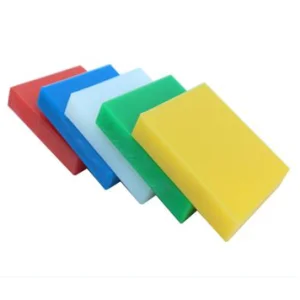
Yes. We formulate customized compound blocks. For sliding friction, we manufacture Oil-Filled Cast Nylon (green/yellow) and Molybdenum Disulfide filled grades (MoS2 grey/black) which drop dynamic friction to ~0.12. For semiconductor or explosive dust environments (ATEX), we produce carbon-black ESD conductive and antistatic polyamide compounds with controlled surface resistivity from 10^5 to 10^9 ohms/sq.
What are your minimum order quantities (MOQ) and lead times for custom block dimensions?
For standard stock sizes (e.g., 600×1200mm, 1000×2000mm up to 100mm thickness), we maintain immediate rolling inventory with zero strict MOQ. For custom formulations, specific masterbatch colors, or custom-dimension thick cast blocks (up to 300mm+), typical trial minimums range from 300 to 500 kg. Standard factory lead time for container orders is 10 to 18 business days from engineering sign-off.
How do you handle moisture-expansion issues when designing tight-tolerance finished parts?
Polyamides are hygroscopic and absorb moisture until reaching ambient equilibrium. When buyers share 2D engineering drawings, our engineering team reviews bearing clearances, operating temperatures, and media exposure. If thermal-moisture swelling will exceed tolerance limits, we recommend either pre-conditioning the blocks, adding thermal compensation tolerances to the CNC toolpath, or substituting with alternative polymers like Polyoxymethylene (POM-C) or PET-P.
Full Product Portfolio
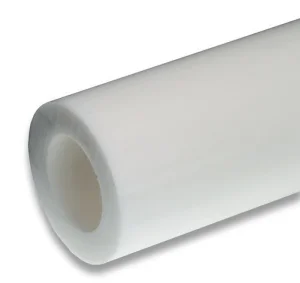
Expanded Engineering Plastic Bars, Tubes & Custom Machined Blanks
Direct supply options for specialized OEM components, extruded profiles, and heavy industrial polymer fabrications.