
Featured Semi-Finished Industrial Polymer Blades & Plates
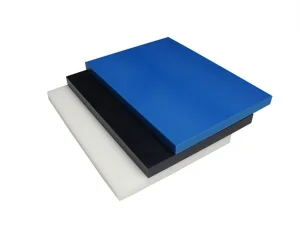
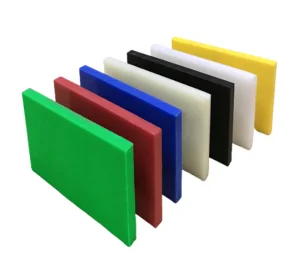
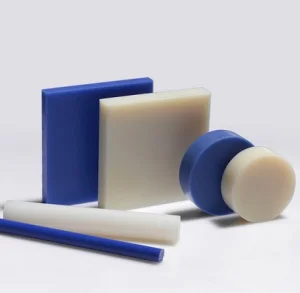
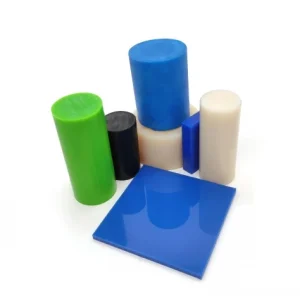
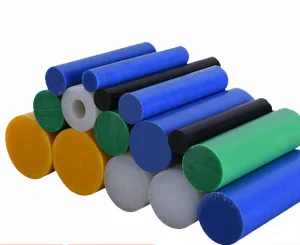
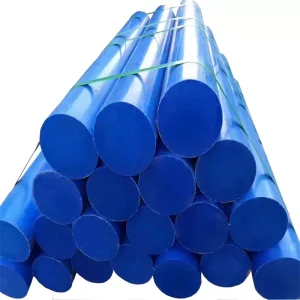
Direct factory production lines covering high-performance PTFE, modified MC Nylon, UHMWPE wear plates, and versatile thermoplastic blanks engineered for direct mechanical installation.
Global Commercial & Industrial Realities of Rubber Blades & Polymer Plates
In modern automated material handling, mining extraction, municipal snow clearance, and high-speed manufacturing, non-metallic wiper systems serve as vital line defense components preventing mechanical downtime.
Transition from Steel to Elastomers
Traditional steel scraper blades induce catastrophic belt laceration and high replacement costs. Industrial facilities have accelerated migration toward co-vulcanized rubber, high-durometer polyurethane (CPU/TPU), and ultra-dense UHMWPE sheets, which lower friction while safeguarding conveyor infrastructures.
Escalating Bulk Material Volumes
Mineral processing plants, thermal power stations, and port terminals operate under relentless continuous loads. Primary scraper blades must possess dynamic tear elasticity, high tensile resilience, and the capability to evacuate moisture without building static charges.
Advanced Co-Polymer Blending
SHUNDA integrates high-molecular-weight polyethylene and reinforced Cast Nylon alongside specialized rubber configurations, providing customized durometer ratings ranging from 65 Shore A to 85 Shore D for aggressive aggregate processing.
Material Engineering Comparison: Rubber Blades vs. Thermoplastic Plates
Balancing shore hardness, friction coefficient, tensile limits, and hydrolysis stability dictates equipment lifespan under relentless shear stress.
| Polymer Category | Hardness Scale | Dynamic Friction (μ) | Operating Temp Range | Ideal Application Scenario |
|---|---|---|---|---|
| Natural / SBR Rubber Blades | 60 - 75 Shore A | 0.45 - 0.65 | -30°C to +80°C | Primary conveyor scrapers, municipal snowplow edge buffers, gravel skirting. |
| Cast Polyurethane (CPU) Blade | 70 - 95 Shore A | 0.25 - 0.35 | -25°C to +85°C | Aggressive mineral processing, wet slurry clearance, secondary belt cleaners. |
| UHMWPE Ultra-Dense Sheet | 60 - 68 Shore D | 0.10 - 0.15 | -150°C to +90°C | Coal bunker chute liners, hopper glide plates, high-speed slider beds. |
| MC Cast Nylon (PA6/PA66) | 78 - 85 Shore D | 0.20 - 0.28 | -40°C to +110°C | Structural wear pads, crane guide rails, outrigger landing blocks. |
| Pure Virgin & Filled PTFE | 55 - 60 Shore D | 0.04 - 0.08 | -200°C to +260°C | Corrosive chemical scraping, cryogenic isolation, high-heat food handling. |
Localized Application Scenarios & Turnkey Industry Solutions
From frigid sub-arctic port installations to underground aggregate mining complexes, SHUNDA elastomeric and polymer plates are purpose-engineered for localized duty cycles.
Mining & Heavy Aggregate Conveyance
The Problem: Premature belt splice failure caused by rigid metallic scraper assemblies in open-pit iron ore transport.
SHUNDA Engineering: We manufacture multi-layer elastomeric wiper blades containing segmented polyurethane cushions backed by low-wear UHMWPE guide blocks, absorbing severe impact while maintaining uninterrupted linear belt sweep.
Municipal Roadway & Airport De-Icing
The Problem: Traditional steel snowplow cutting edges destroy pavement markers, gouge concrete runways, and generate intense noise vibration.
SHUNDA Engineering: Tough co-extruded rubber-ceramic compound blades offer flexibility at -40°C, gliding smoothly over runway utility fixtures while tripling wear durability over standard neoprene.
Chemical Flue & Industrial Wastewater
The Problem: Sludge scrapers subjected to acid bath neutralizers degrade through accelerated chemical softening.
SHUNDA Engineering: Fluoropolymer and high-density polyolefin plates deliver absolute chemical inertness, ensuring reliable automated sediment clearance in industrial settlement tanks.
Technology Roadmap: Next-Gen Elastomer & Polymer Production
How SHUNDA advances OEM polymer fabrication through precision cross-linking, composite formulations, and multi-axis CNC milling.
Phase I: Micro-Cellular Cast Annealing
Minimizing post-cure thermal shrinkage through continuous hydraulic temperature regulation chambers. This process locks in planar flatness for thick nylon sheets and elastomer profiles, eliminating warping during fine CNC turning operations.
Phase II: Nano-Composite Reinforcement
Embedding MoS2 (Molybdenum Disulfide) solid lubricants and graphite platelets into cast MC nylon and polyurethanes, achieving up to 35% lower heat build-up under severe high-velocity abrasion.
Phase III: Smart Embedded Wear Indicators
Engineering co-extruded multi-color strata within scraper blades (e.g., green exterior transitioning to bright orange core), enabling line operators to conduct optical wear assessments during routine walk-bys without halting conveyor machinery.
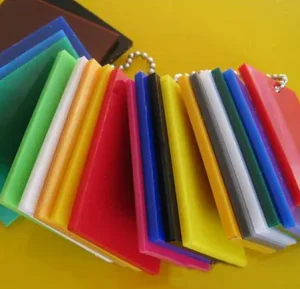
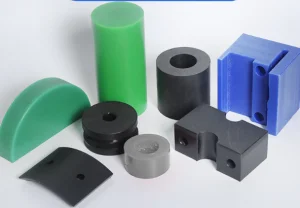
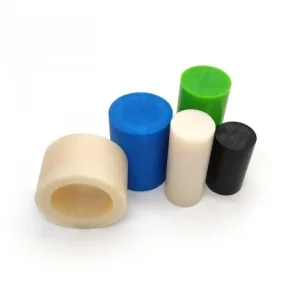
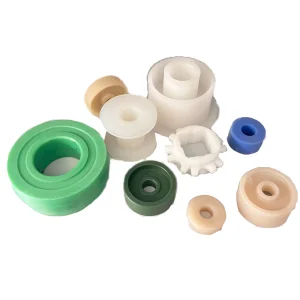
Heavy-Duty Plastic Plates, Solid Blocks & CNC Components
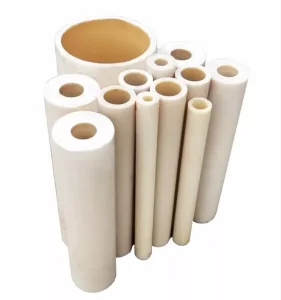
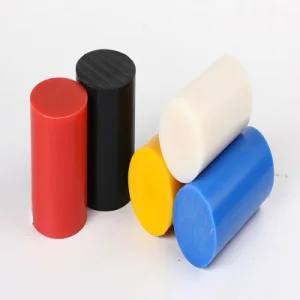
Explore our complementary specialized polymer products: cast nylon sheets, high-tonnage crane outrigger pads, and fully finished custom-machined plastic components built directly from customer blueprints.
Frequently Asked Questions: OEM Polymer & Rubber Solutions
Clear, direct engineering answers to technical queries raised by global procurement specialists, plant engineers, and tier-1 distributor teams.
What is the primary difference between Rubber Blades and Polyurethane Blades in scraping duties?
While natural and SBR rubber formulations yield exceptional flexibility, vibration dampening, and cost efficiency in primary gravel sweeps, cast polyurethane (CPU) provides 3 to 5 times greater tensile tear strength, oil resistance, and edge retention under fine abrasive particulate environments.
Can SHUNDA match custom durometer hardness and custom mounting hole configurations?
Yes. We mill slotted attachment apertures, beveled cutting edges, and multi-tier countersunk drillings directly on our multi-axis CNC machines based on your CAD drawings (DWG, DXF, STEP, or PDF). Durometers can be specifically cast between 60 Shore A to 95 Shore A.
How do you avoid internal stresses and warping in thick cast nylon and plastic plates?
We employ controlled post-polymerization heat soaking (annealing) cycles for all cast MC Nylon, POM, and thick plate profiles. This eliminates internal differential stresses, ensuring components retain dimensional stability without cupping or twisting during subsequent CNC machining.
What is the export turnaround time and packaging protection for overseas sea freight?
Inquiries receive technical review within 12 hours. Standard profiles ship within 10 to 18 business days. For global export, sheets and machined blades are film-laminated, corner-guarded, moisture-desiccant packed, and banded onto fumigated ISPM-15 compliant hardwood pallets.