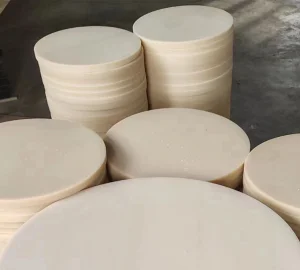
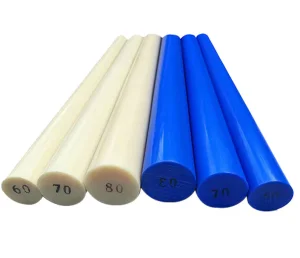
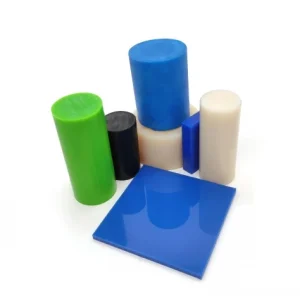
High-Performance Engineering Plastics & Semi-Finished Stock
Explore our core engineering polymer formulations manufactured for heavy industrial hoists, custom crane pulleys, wear guides, and load-bearing machine parts.
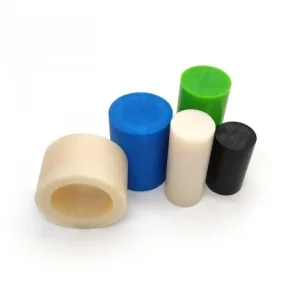

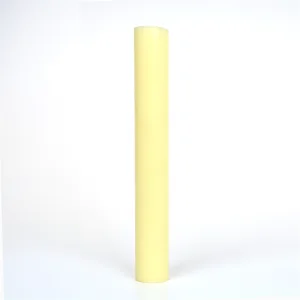

The Global Shift to Engineered Nylon Pulleys: Metallurgical Replacement Dynamics
A technical assessment of why modern engineering sectors are substituting ductile cast iron, cast steel, and bronze pulleys with advanced Polyamide 6 (PA6G) cast sheaves across heavy lifting systems.
In high-tonnage lifting systems, container handling spreaders, offshore cranes, and continuous mine haulage systems, mechanical engineers have historically relied upon gray cast iron (such as GG-25) or welded structural steel sheaves. However, modern operational parameters—driven by demands for higher line speeds, strict seismic weight limits on long crane booms, lower parasitic energy loads, and extended mean time between failures (MTBF)—have positioned Monomer Cast (MC) Nylon (PA6G) as the premier material of choice for industrial pulleys worldwide.
When you evaluate the physics of rotating machinery, a standard cast steel sheave represents an enormous parasitic rotational inertia. Steel's mass density of roughly 7.85 g/cm³ stands in stark contrast to engineered cast nylon's density of 1.15 to 1.18 g/cm³. Replacing metallic pulleys with cast nylon slashes the rotating deadweight by approximately 85%. This radical inertial reduction delivers three decisive structural benefits:
Furthermore, in maritime, coastal harbor, and corrosive chemical settings, cast iron and fabricated steel sheaves suffer from groove oxidation and salt encrustation. This pitted surface converts the groove into an abrasive rasp that grinds through costly hoist ropes. By contrast, Monomer Cast Polyamide exhibits universal resistance to saltwater spray, industrial lubricants, sulfuric traces, and hydrocarbons, creating an enduring mirror-finish contact track that cannot rust.
Cushioning & Vibration Dampening
Cast nylon possesses an internal mechanical loss factor (tan δ) roughly 10 to 15 times greater than structural carbon steel. Shock loads encountered during crane deceleration, snatch-loading, or sudden stops are absorbed by the viscoelastic molecular chains.
- Absorbs cyclical peak torque spikes
- Dampens acoustic resonance below OSHA limits
- Protects delicate boom tip pin assemblies
Self-Lubrication & Zero Cold Welding
Molybdenum disulfide (MoS2) and solid-oil impregnated nylon formulations introduce micronized internal lubrication directly at the boundary friction interface, reducing the dry friction coefficient against steel cables to μ = 0.12 - 0.18.
- Eliminates rope bird-caging from dry slip
- Halts micro-galling and fretting corrosion
- Drastically cuts plant lubrication intervals
Optimized Boom Tip Payload Capacity
On multi-sheave mobile telescopic booms containing 6 to 12 head pulleys, reducing dead load by hundreds of kilograms translates directly into enhanced hook lifting capacity at maximum radius, improving machine stability.
- Minimizes boom deflection at full extension
- Allows smaller counterweights on crane chassis
- Decreases transport weight across regional roads
Comparative Tribological & Mechanical Performance Matrix
Direct laboratory-validated material properties contrasting Monomer Cast Nylon (PA6G) against Grey Cast Iron (GG25) and Medium Carbon Cast Steel (GS-45).
| Property Parameter (Standard / Unit) | Cast MC Nylon (PA6G Natural) | MoS2-Filled MC Nylon (Black) | Grey Cast Iron (GG-25 / EN-GJL-250) | Cast Carbon Steel (GS-45 / 1.0446) |
|---|---|---|---|---|
| Density (ISO 1183, g/cm³) | 1.15 - 1.16 | 1.16 - 1.18 | 7.20 - 7.35 | 7.80 - 7.85 |
| Tensile Strength at Yield (ISO 527, MPa) | 80 - 88 | 85 - 92 | 250 (Ultimate Tensile) | 450 - 550 |
| Modulus of Elasticity (ISO 527, MPa) | 3,200 - 3,500 | 3,400 - 3,800 | 100,000 - 110,000 | 205,000 - 210,000 |
| Dynamic Friction Coeff. vs Steel (μ, Dry) | 0.20 - 0.25 | 0.14 - 0.18 | 0.45 - 0.60 | 0.50 - 0.70 |
| Impact Resistance (Charpy) (ISO 179, kJ/m²) | > 5.0 (No Break) | > 4.5 | 1.5 - 2.5 (Brittle) | 20 - 30 (Ductile) |
| Hardness (Rockwell / Brinell) | M85 - M90 (Rockwell) | M88 - M92 (Rockwell) | 180 - 220 HB | 140 - 170 HB |
| Wire Rope Life Expectancy Factor | 3.5× – 4.5× Baseline | 4.0× – 5.5× Baseline | 1.0× (Rapid Wear Baseline) | 1.2× (High Abrasive Wear) |
| Corrosion Resistance in Marine Air | Immune (100% Inert) | Immune (100% Inert) | Severe (Rapid Pitting) | Severe (High Flaking) |
The decisive differentiator revealed in this mechanical data is the Young's Modulus (Modulus of Elasticity). Cast steel is roughly 60 times stiffer than MC Nylon. When a multi-strand steel hoist rope wraps over a steel pulley groove, the microscopic crowns of the wire strands point-contact the rigid metal shelf, creating severe Hertzian pressure concentrations exceeding 600 MPa. This intense stress rapidly shears the protective core lubricant out of the rope and accelerates steel-wire micro-fatigue fracture.
When operating on an MC Nylon sheave groove, the polymer's elastic modulus permits micro-deflection. The nylon groove deforms elastically to seat the round profile of the entire wire strand bundle. Hertzian stresses plummet to roughly 50–70 MPa. Wire ropes operating across nylon sheaves remain circular, maintain inter-strand internal grease reserves, and demonstrate virtually zero outer wire flattening over thousands of lifting cycles.
High-Demanding Industrial Application Environments
From deep-sea subsea winches to high-speed commercial skyscraper traction lifts, review how customized nylon pulleys solve mission-critical operational challenges.
All-Terrain & Mobile Telescopic Cranes
Boom-head sheaves for 50-ton to 1200-ton mobile cranes. Utilizing oil-cast nylon reduces boom tip deflection, enhances load safety charts, and allows multi-reeving systems to operate with minimal power draw.
- D/d Sheave ratios: 18:1 to 24:1
- High-load double-sealed bearings
- Custom flame-retardant formulation
Offshore & Marine Winches
Shipboard deck winches, offshore drilling platform riser tensioners, and marine crane davits exposed to persistent ocean spray and brine that immediately oxidize metallic pulleys.
- 100% Saltwater imperviousness
- 316 Stainless steel hub inserts
- Anti-fouling polymer compound
Commercial Elevators & Skyscraper Hoists
Secondary deflector sheaves and counterweight pulleys in commercial vertical transport. Cast nylon provides acoustic dampening, eliminating mechanical gear rumble from elevator car cabins.
- Operational noise: < 42 dBA
- Minimal car vibrations
- Meets EN 81-20/50 safety codes
Harbor Port Gantry & Ship-to-Shore (STS)
High-cycle container terminal STS cranes operating 24/7. Accelerated line speeds generate extreme surface friction that burns ordinary sheaves; specialized nylon handles constant friction cycles.
- High surface heat dissipation
- 24/7 Duty cycle endurance
- Extended rope replacement cycles
Why Direct China Factory Sourcing Delivers Unmatched Cost & Quality Metrics
Examining how SHUNDA's vertically integrated chemical monomer synthesis, specialized large-diameter casting kilns, and multi-axis CNC cells redefine global pulley procurement.
Purchasing engineered nylon pulleys internationally has traditionally presented engineering teams with an uncomfortable dilemma: settle for long European/American lead times (12–16 weeks) at steep prices, or risk buying substandard extruded plastics from trading brokers lacking material test certifications. SHUNDA eliminates this trade-off through two decades of specialized focus on industrial polymer monomer casting in Xingtai, Hebei Province.
The manufacturing efficiency of our production plant is anchored in three specific competitive advantages:
Vertical Feedstock Integration
By sourcing raw chemical caprolactam monomer directly from top domestic chemical bases and performing activated anionic polymerization in-house, we eliminate external intermediary raw-material markup.
- Low-cost high-purity virgin resin
- Zero post-consumer scrap blending
- Stable price volatility hedge
Atmospheric Monomer Cast Tooling
Unlike injection molding that requires steel tooling costing tens of thousands of dollars, MC Nylon is cast via atmospheric chemical polymerization in low-cost precision aluminum molds, enabling cost-effective custom runs.
- Custom sheave molds within 5 days
- Diameters from 100mm up to 2000mm
- Low minimum batch requirements
In-House Annealing & CNC Precision
Molded sheave blanks are heat-treated in oil-bath annealing ovens to neutralize molecular residual stresses before machining on heavy-duty vertical CNC lathes.
- Zero post-machining warp or ovality
- Groove runout tolerance: ± 0.05 mm
- ISO 286 bearing press-fit standards
Emerging Technologies Shaping the Industrial Nylon Pulley Industry
Strategic analysis of polymeric advancements, additive nanotechnology, environmental compliance mandates, and smart-wear predictive sheave sensors.
Nanocomposite Reinforcement (CNT & Graphene)
By dispersing functionalized carbon nanotubes (CNTs) into liquid caprolactam monomer, modern research enables nylon pulleys to attain thermal conductivities up to 300% higher than traditional polyamides, rapidly dissipating friction heat away from the rope bed.
Smart Wear-Monitoring RFID Integration
Next-generation cast sheaves embed passive high-frequency RFID chips and conductive polymer strips at precise groove wear thresholds. Once the wire rope wears past 10% of standard depth, automated telematics alert maintenance managers.
ESG Decarbonization Mandates
The manufacturing process for Cast Nylon consumes over 65% less embodied energy than smelting and foundry-pouring gray iron or carbon steel, significantly lowering Scope 3 supply chain carbon emissions for major international OEMs.
Engineering Checklist: Specifying Nylon Pulleys for Global Tenders
Critical mechanical and dimensional variables procurement managers and design engineers must verify prior to releasing manufacturing purchase orders.
1. D/d Sheave Ratio
Ensure the pitch diameter (D) relative to the nominal wire rope diameter (d) complies with DIN 15020 or CMAA specifications (typically 18:1 to 30:1 based on lifting duty class).
2. Groove Profile Radius
Groove radius (r) should measure exactly 0.525 to 0.550 × rope diameter (d). Insufficient radius causes rope crushing; excessive radius reduces the wire support envelope.
3. Metallic Hub Bushings
For high-torque applications or thin web designs, specify cast-in or interference-fit bronze (CuSn12) or AISI 1045 steel center hubs to prevent bearing outer-race creep.
4. Internal Annealing
Confirm suppliers guarantee post-casting thermal oil stress relief. Unannealed nylon blanks suffer bore shrinkage and groove ovalization under heavy operational loads.
Frequently Asked Questions on Nylon Pulley Sourcing & Engineering
Comprehensive engineering clarifications addressing bearing press-fits, moisture hygroscopic expansion, dynamic line loads, and international shipping protocols.
Industrial Engineering Thermoplastics & Heavy Machined Components
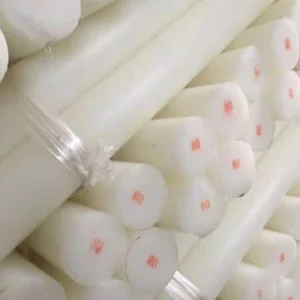
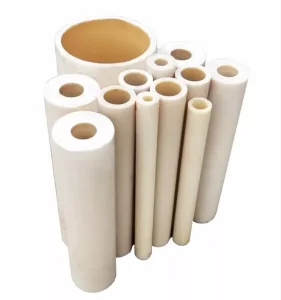
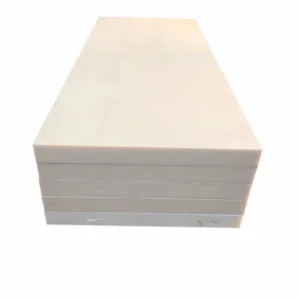
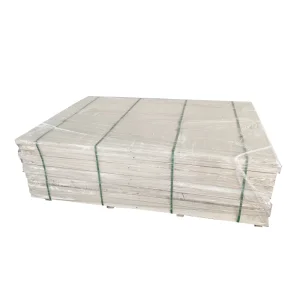
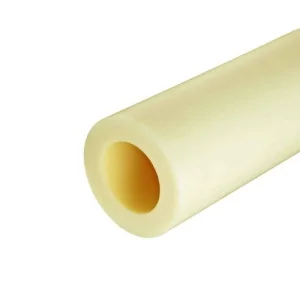
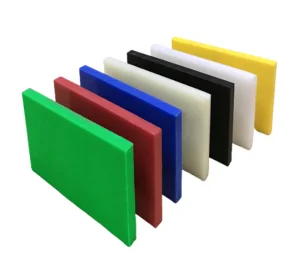
Explore our extended series of cast polyamide rods, customized impact pads, virgin POM/Acetal stock, and wear-resistant polymer tubing available for direct container procurement.