
What Are Polymer Washers Used For?

Time:2026-10-27 Author:Charlotte
0%

What Are Polymer Washers Used For? The answer reaches far beyond simple spacing. These small components distribute clamping pressure, protect surfaces, and help create reliable seals. They appear in pumps, appliances, automotive assemblies, plumbing systems, and electrical equipment. Their value becomes clear when metal parts begin to loosen, corrode, or damage nearby surfaces.

Polymer Washers are made from materials such as nylon, PTFE, PEEK, acetal, and polypropylene. Each material behaves differently under heat, pressure, chemicals, moisture, and repeated movement. Nylon works well in many general-purpose assemblies. PTFE offers very low friction and strong chemical resistance. PEEK supports demanding temperatures, but its higher cost requires careful justification. No material fits every application.

Dr. Tim A. Osswald, a respected polymer engineering educator, puts the design principle clearly: “A polymer part must be designed with its material and process in mind.” That idea matters here. A washer’s diameter, thickness, hardness, and compression behavior can change assembly performance. A thin washer may deform too easily. A thick washer may prevent proper tightening.

Small component. Serious consequences.

In practical maintenance work, technicians often notice the washer only after failure appears. A cracked ring near a pump flange, for example, can signal chemical exposure or excessive compression. Even so, product selection should not rely on habit alone. Temperature records, bolt load, surface condition, and fluid compatibility deserve review. This guide examines those factors and explains where Polymer Washers provide genuine value, while acknowledging where metal or specialized sealing components may perform better.
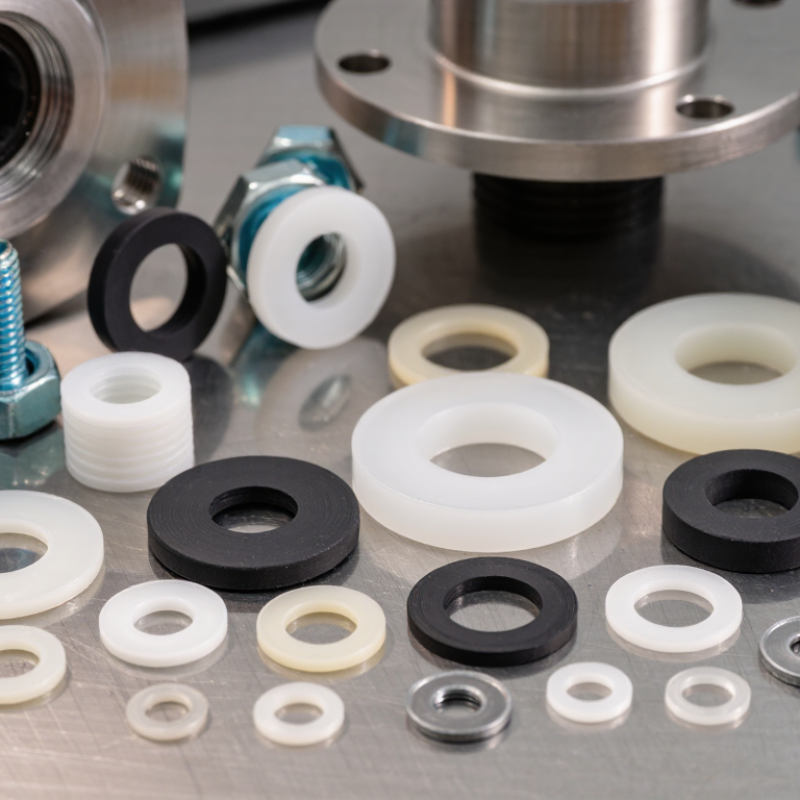
What Are Polymer Washers Used For?

What Are Polymer Washers?

Polymer washers are flat, ring-shaped components made from engineered plastic materials. They sit beneath a bolt head, nut, or screw to spread clamping pressure. Unlike metal washers, they can insulate electrical connections, reduce surface scratching, and resist many chemicals. Common choices include nylon, PTFE, acetal, and high-performance materials such as PEEK. Each behaves differently under heat, moisture, load, and friction. That difference matters.

In a control cabinet, a polymer washer can help prevent a fastener from creating an unwanted conductive path. On painted panels, it can protect the finish from tool marks and concentrated pressure. Engineers also use these washers in pumps, appliances, outdoor enclosures, and low-noise mechanisms. Some versions tolerate vibration better than rigid metal parts when paired with the correct joint design. However, polymer is not automatically safer.

Temperature can cause creep, especially when a joint stays tightly loaded for months. Moisture may change dimensions, while oils or solvents can weaken certain plastics. Choose the material from actual service conditions, not color or low price. Check outer diameter, inner diameter, thickness, load, and temperature range. In practical assembly work, I measure the mating surfaces and test a sample under expected pressure. That step is easy to skip. A washer that looks perfect can deform after repeated heating. Fastener torque should follow the joint design and washer data.

How Polymer Washers Are Designed and Made

What Are Polymer Washers Used For?

Polymer washers are designed to distribute clamping force, isolate surfaces, and reduce vibration. Their performance depends on material selection, geometry, and manufacturing control. A washer may look simple. Its job is not.

Designers first define load, temperature, moisture, chemicals, and installation torque.

Polyamide suits moderate wear and electrical isolation.

PTFE offers low friction and strong chemical resistance, but it can creep under constant compression.

PEEK supports demanding heat and pressure conditions, although its cost requires careful justification.

Manufacturing usually begins with molded sheets, precision machining, or injection molding. Tooling must control inner diameter, outer diameter, and thickness. Small errors can change bolt preload.

Engineers commonly verify dimensions against applicable ISO or ASTM requirements, then test compression, tensile behavior, and thermal aging. Production teams should also inspect flash, cracks, and uneven edges.

The scale of polymer production matters. PlasticsEurope reported global plastics production of 400.3 million tonnes in 2022. That figure reflects a broad material system, not washer demand, but it shows why material traceability matters. Resin batches can vary slightly. Real-world testing remains essential.

A useful washer is not always the hardest one. Overlooking creep is a common design weakness. Field conditions may expose that mistake years later.

Controls should include lot records, dimensional sampling, and application-specific validation. Some projects still rely too heavily on catalog dimensions. That deserves a second look.

Key Properties of Polymer Washer Materials

What Are Polymer Washers Used For?

Polymer washers spread clamp loads, isolate surfaces, and reduce vibration around fasteners. In practical assembly work, material selection often matters more than washer shape. A thin washer can protect a painted panel, but it may fail under heat or constant compression. That detail is easy to miss.

Electrical insulation is a major property. Many polymers resist current flow and prevent metal-to-metal contact. This helps separate conductive parts in housings and control equipment.

Chemical resistance also matters near oils, cleaning fluids, saltwater, or mild acids. No polymer resists everything. Check the fluid, temperature, and exposure time before approval.

Temperature stability controls long-term reliability. Some materials soften near heat sources, while others become brittle in cold rooms. Creep is another concern. Under steady load, a polymer washer may slowly flatten and reduce clamping force. Moisture absorption can change dimensions and strength, especially in humid service. I have seen correct-looking parts loosen after repeated heating and cooling. The cause was not obvious. Designers should compare tensile strength, compression behavior, friction, hardness, and dimensional tolerance. Color alone proves very little. A rigid-feeling washer may still deform under a narrow metal edge. Testing the assembled joint remains the safer choice.

Common Applications of Polymer Washers

What Are Polymer Washers Used For?

Polymer washers are used to separate, protect, and stabilize fastened parts. Their common applications include electrical assemblies, plumbing systems, automotive components, furniture, and light industrial equipment. Unlike metal washers, many polymer types resist moisture, chemicals, and electrical current. This makes them useful around wiring terminals, plastic housings, and painted surfaces.

In electrical equipment, a polymer washer can prevent unwanted contact between a screw and a conductive panel. In plumbing, it may help seal a joint and reduce minor leakage. In machines, it can limit vibration and protect delicate surfaces from scratches. Some washers also distribute clamping pressure across soft materials, such as acrylic sheets or thin composite panels. The correct material still matters. A washer that performs well near water may deform beside a hot motor.

Tips: Check temperature, chemical exposure, load, and screw size before installation. Keep the washer flat and centered. Do not overtighten it, because excessive pressure can cause cracking or permanent deformation. A common mistake is treating every polymer washer as interchangeable. That approach seems convenient, but it can reduce service life. Inspecting the washer after tightening is worthwhile, even when the assembly looks simple. Small details, such as a crushed edge or uneven seating, may signal a larger fit problem.

What Are Polymer Washers Used For? - Common Applications of Polymer Washers

Application Typical Polymer Washer Material Primary Function Why Polymer Washers Are Suitable Important Considerations
Electrical insulation Nylon, polycarbonate, or PTFE Separates fasteners from conductive surfaces and helps prevent unintended current paths. Most common engineering polymers are electrically nonconductive and lightweight. Check dielectric requirements, moisture absorption, voltage, and temperature conditions.
Corrosion isolation Nylon, acetal, or PTFE Creates a nonmetallic barrier between dissimilar metals or between a fastener and a coated surface. Helps reduce direct metal-to-metal contact and can resist moisture and many chemicals. Polymer washers do not replace correct sealing, drainage, coatings, or compatible fastener selection.
Surface protection Nylon, polyethylene, or polyurethane Distributes clamping force and reduces scratching, denting, or marring of finished surfaces. Their softer surfaces can cushion panels, painted parts, plastics, and decorative finishes. Excessive tightening can permanently deform the washer or damage the protected surface.
Vibration and noise reduction Polyurethane, elastomeric polymers, or rubber-like thermoplastics Adds compliance between components and can help reduce rattling, impact, and structure-borne noise. Flexible materials can absorb limited vibration and accommodate minor movement. Select the material and hardness according to load, frequency, compression, and environmental exposure.
Sealing and fluid containment PTFE, EPDM, or other application-specific elastomers Helps seal interfaces against water, air, oils, or selected process fluids when designed for that purpose. Certain polymers provide low permeability, chemical resistance, or elastic recovery. A flat washer is not automatically a pressure-rated gasket; verify compression, surface finish, and media compatibility.
Low-friction movement PTFE, acetal, or ultra-high-molecular-weight polyethylene Provides a bearing-like interface for light-duty pivoting or sliding connections. These materials generally offer low friction and good resistance to wear in suitable conditions. Evaluate load, sliding speed, temperature, lubrication, and wear rate before substituting for a bushing.
Thermal isolation Nylon, PEEK, PTFE, or glass-filled engineering polymers Reduces direct heat transfer through a bolted connection. Polymers generally conduct less heat than metals and can electrically isolate components at the same time. Confirm continuous-use temperature, compressive strength, creep resistance, and thermal expansion.
Weight reduction Nylon, polypropylene, polyethylene, or acetal Replaces heavier metal washers in noncritical, low-to-moderate load assemblies. Polymer components have lower density than steel and are easy to handle and install. Do not use a lightweight polymer washer where high preload, elevated temperature, or structural certification is required without engineering review.

Selection note: The appropriate polymer washer depends on load, temperature, moisture, chemicals, electrical requirements, surface condition, and expected service life. Material performance varies by grade, thickness, and washer design.

How to Select the Right Polymer Washer

Selecting the right polymer washer begins with the joint, not the catalog. Identify the bolt size, clamping force, and contact surfaces. A washer for a light cover may fail under a vibrating motor. Measure twice. Guessing is costly.

Material choice depends on temperature, moisture, chemicals, and electrical requirements. Nylon suits many general-purpose assemblies and provides useful insulation. PTFE handles demanding chemical exposure and low-friction contact. Polypropylene can perform well in damp environments, but heat may limit it. Check the washer’s working temperature, compressive strength, and resistance data. Do not rely on appearance alone.

Geometry matters just as much. The inner diameter should fit the fastener without binding. The outer diameter should spread pressure across the surface. A thin washer may deform against soft plastic, while a thick washer can reduce thread engagement. For outdoor equipment, consider ultraviolet exposure and water absorption. For electrical assemblies, verify dielectric performance and surface cleanliness. Hand-tightening can also change results; excessive torque may crush the polymer and loosen the joint later. I have seen a washer selected correctly on paper perform poorly because the mating surface was uneven. That detail is easy to miss. Test a small assembly under realistic load, temperature, and vibration before approving a larger installation. Records of torque, dimensions, and test conditions make future selection more reliable.

What Are Polymer Washers Used For? How to Select the Right Polymer Washer

Polymer washers help distribute clamping loads, provide electrical insulation, reduce surface damage, and resist moisture or chemical exposure. The chart compares typical upper continuous-use temperatures for commonly selected polymer washer materials. Actual limits vary by grade, load, chemical environment, and exposure time.

Selection guide: choose nylon or acetal for general-purpose fastening and low friction, PTFE for strong chemical resistance and very low friction, PEEK for demanding high-temperature applications, and UHMWPE where low moisture absorption and excellent wear resistance are important.

FAQS

What are polymer washers used for?

They spread clamp loads, protect surfaces, isolate metals, and reduce vibration around fasteners. A thin washer may protect paint but fail under heat.

Why is material selection important?

Material affects insulation, chemical resistance, temperature stability, creep, moisture absorption, and compression strength. Shape alone cannot predict performance.

Which conditions should be checked before choosing a washer?

Check bolt size, clamping force, temperature, moisture, chemicals, vibration, and electrical requirements. Do not trust appearance alone.

How do polymer washers support electrical insulation?

They can prevent metal-to-metal contact and reduce current flow between conductive parts. Clean surfaces still matter.

How can heat and cold affect polymer washers?

Heat may soften a washer, while cold may make it brittle. Repeated heating and cooling can gradually loosen a joint.

What is polymer washer creep?

Creep is slow deformation under constant load. The washer may flatten, reducing clamping force over time.

How should washer dimensions be selected?

The inner diameter should fit without binding. The outer diameter should spread pressure across the contact surface. Thickness also affects thread engagement.

Can a polymer washer fail even when selected correctly?

Yes. An uneven mating surface or excessive hand-tightening can crush it. The paper selection may look correct. Assembly testing can reveal the mistake.

Conclusion

Polymer Washers are lightweight, nonmetallic components designed to distribute pressure, prevent surface damage, and improve the performance of fastened assemblies. They are produced from engineered plastics and elastomers using processes such as molding, cutting, or machining. Their design can be adjusted to meet specific requirements for thickness, diameter, flexibility, temperature resistance, chemical stability, and electrical insulation. These characteristics make polymer washers useful in environments where traditional metal washers may corrode, conduct electricity, or add unnecessary weight.

Common applications include machinery, electronics, automotive systems, plumbing equipment, renewable energy installations, and general construction. Polymer Washers can help reduce vibration, isolate dissimilar materials, seal against moisture, and minimize noise during operation. Selecting the right washer requires evaluating the load, fastening size, operating temperature, exposure to chemicals or weather, required durability, and the compatibility of the material with surrounding components. A proper choice improves reliability, protects surfaces, and supports longer service life.

Charlotte

Charlotte

Charlotte is a seasoned marketing professional with a deep understanding of the company's portfolio and a passion for elevating its presence in the market. With a keen eye for detail and a commitment to excellence, she ensures that our professional blog is regularly updated with insightful articles......