
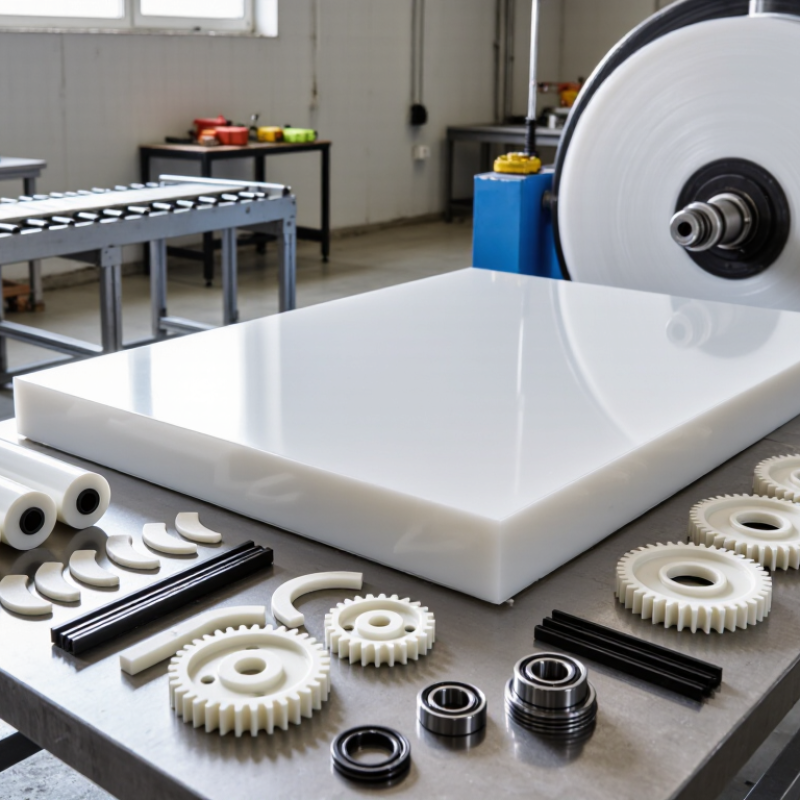
What Is Nylon Polymer Sheet Used For? The answer begins with its balance of strength, low friction, and practical machinability. Nylon Polymer Sheet is commonly used for wear pads, guide rails, rollers, gears, seals, bearings, and protective machine components. It can reduce metal-to-metal contact in conveyor systems. It also performs well in workshops where parts need drilling, cutting, or turning.
Dr. Wallace H. Carothers, the DuPont chemist who developed nylon, explained the material’s broader principle: “The properties of polymers depend on their molecular structure.” That idea still matters today. Different nylon grades can change hardness, moisture absorption, impact resistance, and dimensional stability. Nylon 6, nylon 66, and cast nylon may look similar on a warehouse shelf. Their service behavior can differ sharply.
A well-selected Nylon Polymer Sheet can withstand repeated movement and moderate chemical exposure. It may also help lower noise around rotating equipment. In a factory, a six-millimeter sheet might become a sliding guide, while a thicker plate could support a wear strip. Small details matter.
No sheet is perfect. Nylon can absorb moisture, expand, and lose precision in humid conditions. Continuous heat may also reduce its working life. I have seen material choices fail when designers focused only on tensile strength. The better approach checks load, speed, temperature, lubrication, moisture, and installation space together. Engineers should confirm technical data with the supplier before production. That extra step feels slow. It often prevents expensive rework.
What Is Nylon Polymer Sheet Used For?
Nylon Polymer Sheet Basics: Grades, Structures, and Melting Points up to 265°C
Nylon polymer sheet is used for gears, wear pads, rollers, guide rails, seals, and electrical spacers. Its low friction helps moving parts slide smoothly. Its toughness also helps it withstand repeated impacts. Common grades include PA6, PA66, and PA12. Each grade behaves differently under heat, moisture, and mechanical load.
PA6 typically melts near 220–225°C, while PA66 can reach approximately 255–265°C. PA12 melts at a lower range, often near 175–180°C. These figures describe melting points, not safe working temperatures. A sheet may soften, deform, or lose strength long before melting. That distinction is easy to overlook.
Structure matters as much as grade. Nylon is usually semi-crystalline, with ordered regions that improve strength and wear resistance. Glass-fiber reinforcement can increase stiffness, but it may reduce impact tolerance. Moisture absorption can also change dimensions, especially in PA6 and PA66 sheets. Keep this in mind.
In practical selection, check load, speed, temperature, humidity, and chemical contact together. A dry workshop test may not represent field conditions. The neatest specification can still be incomplete. For tight-tolerance parts, conditioning the sheet before machining can improve accuracy. However, the required conditioning time depends on thickness, grade, and surrounding humidity.
What Is Nylon Polymer Sheet Used For?
Mechanical Performance: Tensile Strengths Commonly Reaching 70–90 MPa
Nylon polymer sheet is widely used for machine parts that need strength, low friction, and impact resistance. Common applications include gears, guide rails, wear strips, rollers, bushings, and protective covers. Its tensile strength often reaches 70–90 MPa, depending on the grade and test conditions. That figure matters.
In practical fabrication, technicians can machine nylon sheets into accurate components without the brittleness associated with many rigid plastics. A properly selected sheet can handle repeated contact with metal surfaces and reduce operating noise. It also resists many oils and fuels, although chemical compatibility should be checked before production. Nylon is not automatically suitable for every environment.
Moisture deserves attention. Nylon absorbs water, which can improve toughness but reduce stiffness and dimensional stability. A damp sheet may no longer match the dimensions measured when dry. Temperature also changes its performance, especially under continuous load. Designers should not treat 70–90 MPa as a guaranteed working stress. Safety factors, thickness, loading direction, and support conditions remain essential. A simple tensile value cannot predict creep or long-term deformation. Real projects sometimes expose this gap too late. Testing a sample under actual humidity, temperature, and load conditions provides more reliable engineering evidence.
| Application Area | Typical Components | Relevant Nylon Sheet Property | Typical Data or Performance Range | Why Nylon Sheet Is Used |
|---|---|---|---|---|
| Industrial machinery | Wear strips, guide rails, rollers, bushings, spacers | Tensile strength | Approximately 70–90 MPa for many unfilled nylon grades under standard test conditions | Provides a strong, lightweight alternative to many metallic components while reducing sliding noise. |
| Conveyor systems | Chain guides, sprocket components, side guides, wear pads | Coefficient of friction | Commonly about 0.20–0.35 in dry sliding applications, depending on load, speed, surface finish, and mating material | Supports smooth movement and helps limit friction-related wear in conveying equipment. |
| Material handling equipment | Bearings, rollers, impact pads, chute liners | Density | Typically about 1.13–1.15 g/cm³ for unfilled nylon 6 or nylon 6/6 | Offers lower mass than steel while maintaining useful mechanical strength and dimensional stability. |
| Electrical and control equipment | Insulating plates, terminal supports, mounting parts, protective covers | Electrical insulation | Generally a good electrical insulator when clean and dry; moisture absorption can reduce insulation performance | Combines mechanical support with electrical isolation in moderate-temperature environments. |
| Automotive and transport equipment | Gear components, thrust washers, cable guides, structural brackets | Continuous-use temperature | Often suitable for approximately 80–100°C continuous service, depending on grade, load, and environment | Provides low weight, vibration damping, and good resistance to many automotive fluids and oils. |
| Food-processing machinery | Wear pads, guide blocks, rollers, change parts | Water absorption | Nylon can absorb approximately 1.5–3% water by weight under common conditioning conditions; values vary by grade and exposure | Useful where low friction and wear resistance are important, provided the selected grade meets applicable hygiene requirements. |
| Pump and fluid-handling equipment | Valve seats, wear rings, seals, impeller components | Chemical resistance | Generally resistant to many oils, greases, and hydrocarbons; performance may decrease with strong acids, strong bases, or prolonged hot-water exposure | Supports reliable service in selected chemical and fluid environments without using metal for every component. |
| Fabrication and prototyping | Machine guards, covers, jigs, fixtures, custom wear parts | Machinability | Can be sawn, drilled, milled, and turned using suitable tooling and controlled cutting conditions | Allows manufacturers to produce custom low-friction parts without specialized molding equipment. |
| Structural and load-bearing parts | Support plates, mounting blocks, rollers, brackets | Flexural modulus | Commonly around 2.0–3.0 GPa for unfilled nylon, with strong dependence on moisture and temperature | Provides useful stiffness for moderately loaded parts while retaining impact resistance and low weight. |
| Noise and vibration control | Machine liners, sliding pads, isolation components | Impact resistance | Typically tougher and less brittle than many rigid thermoplastics; exact impact values vary significantly by grade and conditioning | Helps reduce transmitted noise and withstand intermittent shock loads in mechanical assemblies. |
Note: Mechanical values are representative ranges for unfilled nylon sheet, commonly based on nylon 6 or nylon 6/6. Actual performance depends on polymer type, moisture conditioning, temperature, sheet thickness, processing method, test standard, load, and exposure environment.
Nylon polymer sheet is widely machined into industrial gears, bearings, rollers, and wear-resistant components. Its low density helps reduce moving mass, while its toughness supports repeated impact and sliding contact.
The U.S. Department of Energy reports that a 10% vehicle weight reduction can improve fuel economy by roughly 6–8%. This principle also matters in conveyors, packaging equipment, and material-handling systems.
In gears, nylon can reduce noise and protect mating metal surfaces. In bearings, it may operate with limited lubrication when loads and temperatures remain controlled.
Rollers made from nylon polymer sheet resist abrasion and often create less marking on finished products.
According to the Plastics Industry Association’s 2023 data, plastics remain central to durable manufacturing, with engineering polymers serving demanding mechanical applications.
The exact performance depends on moisture, speed, pressure, and shaft design.
Designers should check thermal expansion before replacing metal parts. Nylon absorbs moisture, which can change dimensions and stiffness.
That detail is easy to overlook.
A 2024 engineering plastics market analysis by Grand View Research identifies automotive, electrical, and industrial equipment as major demand areas for polyamide materials. Still, market growth does not prove every application is suitable.
In practical testing, engineers should measure wear, noise, temperature, and dimensional change under real operating loads. A simple workshop trial may reveal problems that a datasheet misses.
Nylon polymer sheet is used for wear pads, guide rails, gears, rollers, seals, and machined machine guards. Its low friction and impact resistance suit moving parts that would quickly damage softer plastics. In workshop conditions, nylon is also easier to cut, drill, and shape than many high-performance polymers.
Typical nylon 6 and nylon 6/6 sheets melt near 220–265°C, but continuous service limits are much lower. Many engineering data sheets place practical dry-service temperatures around 80–120°C. ISO 75 heat-deflection testing shows why load matters: a lightly loaded sheet survives heat better than a compressed bearing surface. A warm, heavily loaded part may deform early.
Moisture changes everything. ASTM D570 data commonly show water absorption around 1–3% after 24 hours, depending on grade and conditioning. Nylon can swell, lose stiffness, and change dimensions near washdown areas or humid equipment. Allow clearance around drilled holes. Strong acids, concentrated alkalis, and oxidizing chemicals can attack nylon, while oils, fuels, and dilute alkaline cleaners are usually less aggressive. Verify compatibility against the actual concentration and temperature. That matters.
A dry laboratory result can mislead. I would not treat one material table as a guarantee. Published ISO and ASTM results describe controlled specimens, not a sheet exposed to heat, moisture, pressure, and chemical cycling. Test a small cut section first, especially when tolerances are tight or failure could stop production.
What Is Nylon Polymer Sheet Used For?
Selection Guide: Comparing Nylon 6, Nylon 6/6, and Reinforced Sheet Grades
Nylon polymer sheet supports gears, wear pads, rollers, guides, and machine guards. Its low friction helps moving parts run quietly. Its strength also suits electrical supports and chemical-handling components. The choice is not perfectly simple. Nylon 6 generally offers easier processing and better impact performance. Nylon 6/6 usually provides higher stiffness and heat resistance. Industry technical data commonly places melting points near 220°C for Nylon 6 and 255°C for Nylon 6/6. Actual results vary by moisture, thickness, and test method.
Reinforced grades add glass fiber or mineral fillers. These grades can reduce deformation under load, which matters in bearing blocks and structural panels. However, reinforcement may increase brittleness and surface wear against mating parts. A 2024 Grand View Research report valued the global nylon market at more than 30 billion US dollars, reflecting broad demand across transportation, electronics, and industrial equipment. ASTM D570 data also shows that nylon absorbs significant water, often near 1–2% by weight for dry, unfilled grades after conditioning. Dimensions can change.
Tips: Match the sheet to its working environment, not only its tensile strength. Use Nylon 6 for impact-sensitive parts and general fabrication. Consider Nylon 6/6 for hotter, stiffer applications. Choose reinforced sheet for sustained loads, but check machining behavior. Ask for conditioned test data. Dry laboratory values can mislead.
The chart compares representative dry tensile-strength values for common nylon sheet material categories. Nylon 6 and Nylon 6/6 are widely used for wear pads, rollers, gears, bushings, guides, and general-purpose machine components. Glass-fiber-reinforced nylon is selected when higher stiffness, dimensional stability, and load capacity are required. Actual values vary with processing method, moisture content, temperature, reinforcement percentage, and grade formulation.
It is machined into gears, rollers, guide rails, wear pads, bushings, seals, and electrical spacers.
Common grades include PA6, PA66, and PA12.
PA6 melts near 220–225°C.
No. Nylon may soften, creep, deform, or lose strength long before melting.
Many grades reach approximately 70–90 MPa under specific test conditions.
Nylon absorbs water from surrounding air.
It can reduce noise, moving mass, and friction in controlled applications.
Glass fibers usually increase stiffness and dimensional stability.
Conditioning can improve accuracy in close-tolerance parts.
Nylon Polymer Sheet is a durable engineering material valued for its balance of strength, wear resistance, low friction, and machinability. Available in grades such as Nylon 6, Nylon 6/6, and reinforced formulations, it can be produced with different molecular structures and performance characteristics. Depending on the grade, melting points may reach approximately 265°C, while tensile strength commonly falls within the 70–90 MPa range. These properties make nylon sheet suitable for gears, bearings, rollers, guide components, wear strips, and other mechanical parts that require reliable performance under repeated movement and load.
However, material selection should consider real-world operating conditions. Nylon can absorb moisture, which may affect its dimensions, stiffness, and strength, while prolonged exposure to high temperatures, chemicals, or heavy loads can reduce service life. Nylon 6 often offers a practical balance of toughness and processing ease, whereas Nylon 6/6 generally provides higher stiffness and heat resistance. Reinforced sheet grades may deliver improved dimensional stability, strength, and wear performance for demanding applications.
